The Stripe That Crossed the Sea
A brief history of the pattern that became summer — from a sailor's uniform to the sunlit coast of Italy.
There is a particular kind of morning that belongs entirely to summer.
You recognize it before you open your eyes. The light comes through the curtains differently — softer and brighter at the same time, like it came from somewhere closer to the water. The air moves. Someone somewhere is making coffee. And you know, before you've done a single thing, that today is a beach day.
You reach for the bag on the hook by the door. The one with the stripes.
You've been doing this for years. So, it turns out, has almost everyone else. The striped canvas bag — that soft, effortless, somehow-always-right companion — has been the vessel of summers past for longer than you'd imagine. Its history begins not on a beach, but on a ship. Not in Italy, but in France. And it arrives here, in your hands, after a journey that took the better part of two centuries.
This is where the stripe came from. And why it still feels like summer.
1858: The stripe begins at sea
The striped pattern we now call coastal, Mediterranean, nautical, Italian — it was none of those things at first.
In 1858, the French government issued a decree standardizing the uniform of the Breton sailors of the French Navy. The garment was called the marinière, and it was striped horizontally in navy blue and white — twenty-one stripes on the front, twenty-one on the back. The number was not accidental. It matched, to the count, the number of victories Napoleon had won over England.
The stripe was, in the beginning, a record of conquest. A number stitched into cotton.
But the marinière was also brilliantly practical. The horizontal stripes made sailors easier to spot against the sea — a man overboard in a striped shirt was a man who could be found. The uniform was snug enough not to catch wind, durable enough to survive salt water, and distinctive enough to be identified at a distance. The French Navy wore it for decades without anyone thinking it was particularly beautiful.
Then, in 1917, Coco Chanel went to Deauville.
1917: A designer and a fishing village
Deauville is a small resort town on the coast of Normandy, and in the early twentieth century it was where Parisian society went to breathe sea air and feel pleasantly bohemian. Chanel had a boutique there, and she spent time on the docks, watching the fishermen and the sailors go about their work.
She borrowed the marinière. Took it off the sailor, simplified the collar, softened the fit, and put it on wealthy women who had never spent a day at sea in their lives. She called the look marin — naval — and Paris called it revolutionary.
It was the first time the stripe crossed from utility to desire. From what you wore to survive the water, to what you wore to love it.
From Paris, the stripe spread south. Down through Provence, past Marseille, and eventually across the Ligurian Sea to the Italian coast.
The Italian Riviera and the birth of summer style
There is a stretch of Italian coastline, beginning roughly at Genoa and curving southward through Cinque Terre, Portofino, and into the Gulf of Poets, that has been called the most beautiful shoreline in the world by enough different people in enough different centuries that it might simply be true.
After the Second World War, this coast became something more than beautiful. It became the place where Europe went to remember what pleasure felt like.
The 1950s and 1960s were the years the Italian Riviera invented the modern beach vacation. Hotels reopened. Fishermen's villages became fashionable. Film directors and artists and writers arrived from Rome. Brigitte Bardot was photographed in Portofino in 1956 wearing a striped top and wide trousers, holding nothing — because that was the thing about the Italian coast: it asked nothing of you.
You arrived, you put down what you were carrying, and you sat in the sun.
The aesthetic that emerged from this decade — what we now call Italian coastal — was built on softness and effortlessness. Natural linen. Leather sandals. Wide hats. The smell of espresso and sunscreen and the sea. And the stripe, which had crossed from the French navy to the French boutique to the Italian cliff-side café, arrived exactly on time.
On the Italian coast, the stripe stopped being nautical. It became something softer. It became the color of having nowhere to be.
The canvas bag: a separate history
While the stripe was making its way across the Mediterranean, the canvas tote was undergoing its own quiet revolution on the other side of the Atlantic.
The bag we now call a tote — open-topped, two handles, made to carry things — is older than it looks. Canvas bags have been used for cargo and goods since the seventeenth century. But the fashion tote, the kind you choose because it pleases you, came into existence in a specific moment.
In 1944, the American outdoor company L.L. Bean designed a heavy-canvas bag to carry blocks of ice from the car to the icebox. It was functional, inelegant, and completely unconcerned with being beautiful. It had two short leather handles and a flat bottom. It became, almost by accident, one of the best-designed bags in American history.
By the 1960s, the canvas bag had migrated from utility to culture. Museums and universities began printing their names on canvas totes and selling them as cultural objects. The New York Public Library's tote, introduced in the early 1970s, became one of the most recognizable objects in the city — a signal that you were the kind of person who went to the library, who cared about books, who carried your life in something unpretentious and good.
The tote was democratic in a way that most fashion objects weren't. It made no claims. It held whatever you brought to it.
When the stripe arrived on the canvas bag — sometime in the late 1970s, with the growing appetite for Mediterranean travel — it was, in retrospect, inevitable. Two histories converging. The pattern that meant the sea, on the bag that meant freedom.
"Ciao Bella" — and what it actually means
The phrase has been on the bag since it was designed, printed in soft script lettering below the stripes.
Ciao Bella.
In Italian, it means simply: Hello, beautiful. It is the greeting a shopkeeper gives you when you push open the door on a summer morning. The thing a woman says to her friend across the piazza. It is warm without being intimate, familiar without being presumptuous. It assumes beauty — not the anxious kind, but the quiet kind that belongs to anyone who has come out into the light.
The phrase is old — ciao derives from the Venetian word s-ciào, meaning "your slave" or "I am at your service," used in the 16th century as a greeting between equals. Over time it shed its formal weight and became simply the warmest sound in the Italian language: the sound of arriving somewhere welcome.
Bella — beautiful — is older still. Its root is the Latin bellus, meaning lovely or fair, and it has been used to address women in Italian since the language was born. It is not a compliment that evaluates. It is a greeting that assumes. You are beautiful is not said because you have done something to earn it. It is said because you are here, and it is summer, and that is enough.
Together the words make something that functions less like a compliment and more like a welcome. Ciao Bella is the Italian coast saying: you arrived. The sun is out. Whatever you left behind at home — it can wait.
Why the stripe still feels like summer
There is a theory in color psychology that horizontal lines make the eye move — left, right, left — the way waves move. That the brain, seeing stripes, recognizes water before it recognizes anything else. That we have been trained, by enough summers and enough coastlines and enough photographs of women in striped tops standing at the edge of the sea, to feel the stripe as a promise.
Whether or not the theory is entirely true, the feeling is.
A striped bag says: somewhere warm is coming. Somewhere you'll be barefoot on stone, or salt-damp on your shoulders, or laughing at a table outside. Somewhere there is no itinerary, only weather and appetite and good company.
That is what the stripe has always carried — from the French sailor's back to the Italian Riviera café to the canvas bag on your hook by the door.
The six colors, and what they hold
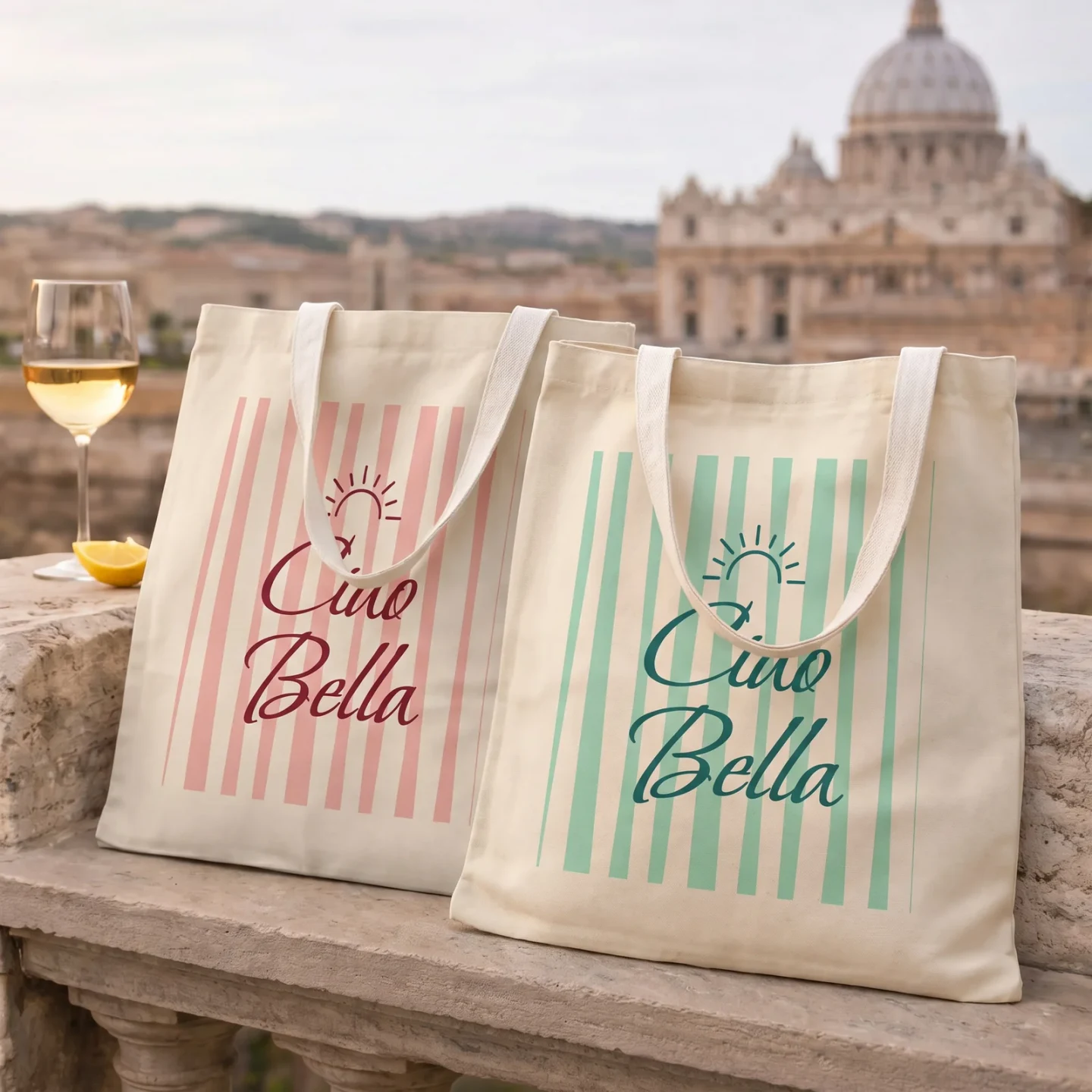
Each stripe, a different summer
What to carry in it
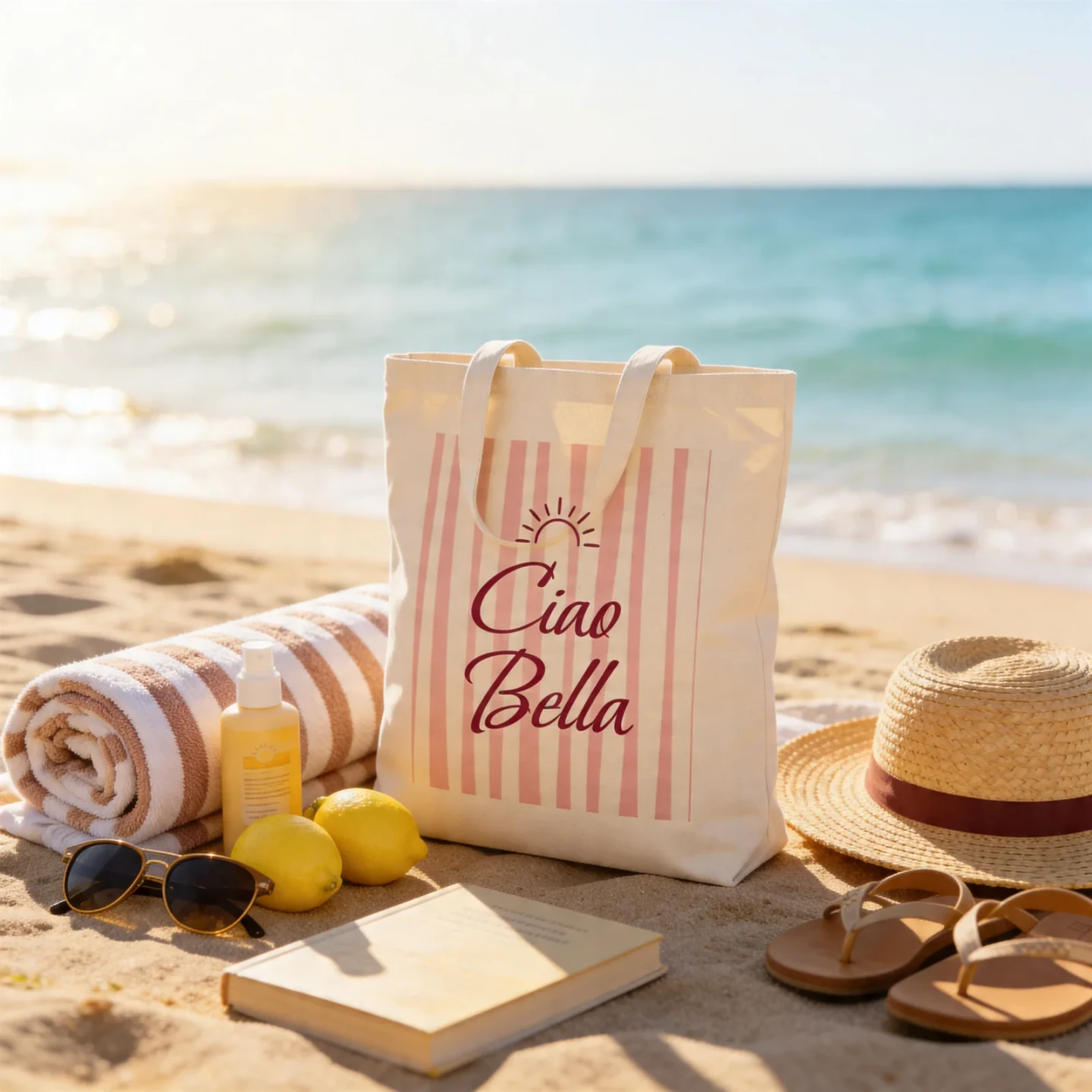
The bag is 15 by 16 inches — wide enough to hold a beach towel folded twice, deep enough for a paperback and a water bottle and the small accessories of a day with nowhere particular to be.
But the bag also holds other things. The kind that don't have dimensions.
For the beach day
- A paperback you've been saving — the one you keep meaning to start and never quite have the stillness for
- A linen towel — not the beach-resort kind, the kind you fold carefully and unpack like a small ceremony
- Sunscreen and a lip balm that smells faintly of coconut or something else that belongs at the water
- Something to eat at noon — a peach, a wedge of cheese, bread bought from somewhere this morning
- The good sunglasses, wrapped in the soft cloth they came in
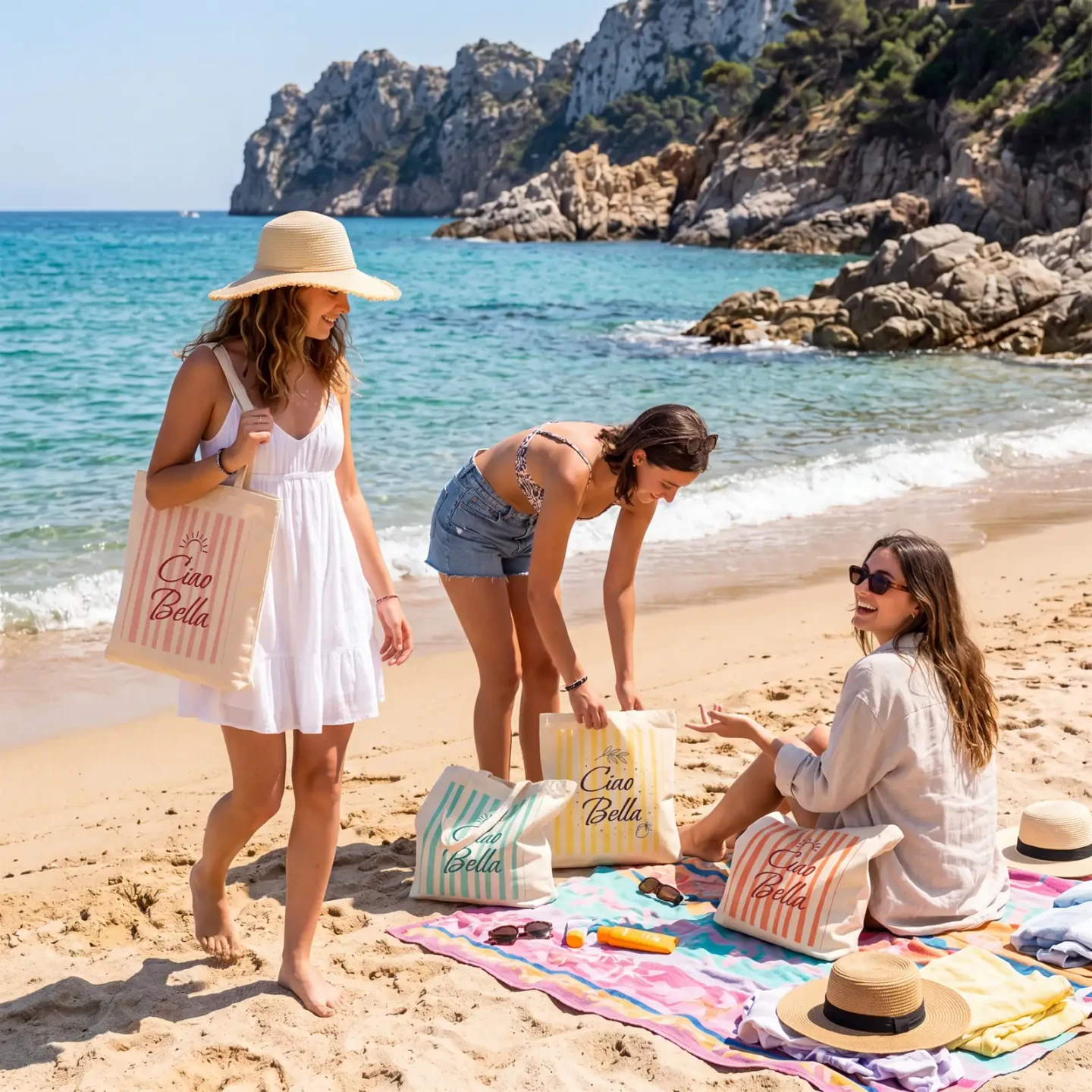
For the girls trip
- A shared playlist already downloaded for the drive
- Everyone's sunscreen because someone always forgets
- A journal for the things you'll want to remember when you're back at your regular life
- Snacks for the road that are slightly better than sensible
- A small gift for the friend who planned everything and acts like it was nothing
The set is lovelier.
One bag per woman, in the color that suits her. The Lemon for the one who always finds the sun. The Blush for the one who photographs beautifully. The Aqua for the one who swims. You'll recognize each other at the beach by your stripes — which is, in a way, what the first sailors were doing too.
The bag as a small act of optimism
There's something worth saying about what it means to pick up a bag like this one.
You are not packing for anything serious. You are not preparing for difficulty. You are simply gathering the things that make a day beautiful, and putting them somewhere soft to carry.
The striped tote is one of the oldest acts of summer optimism. Sailors wore the stripe to be visible in the water. Chanel wore it because she found joy in the functional. The Italian coast wore it because joy, it turns out, is not complicated — it requires only the right place, the right company, and something to carry your things in while the sun is out.
The bag doesn't know any of this history, of course. It is just canvas and stripes and a soft, confident declaration that somewhere warm is coming.
But you know. And that is part of the pleasure of carrying it.
Ciao Bella.
The Ciao Bella Striped Tote · Canvas · 15" × 16" · Six stripe colors · Machine washable.
Lightweight enough for a day at the water. Wide enough for everything you need there.
SAVE THIS FOR YOUR NEXT BEACH DAY
- Pin this to your Summer Style or Beach Bag Ideas board
- Save it to Italian Travel Inspo or Girls Trip Planning
- Send it to the friend who always finds the best bags
- Bookmark it for the vacation you've been meaning to take
Soft gifts, sentimental ideas, and the occasional piece of history — delivered gently to your inbox.
PDF · Sent to your inbox · Free forever
No noise. Unsubscribe any time.